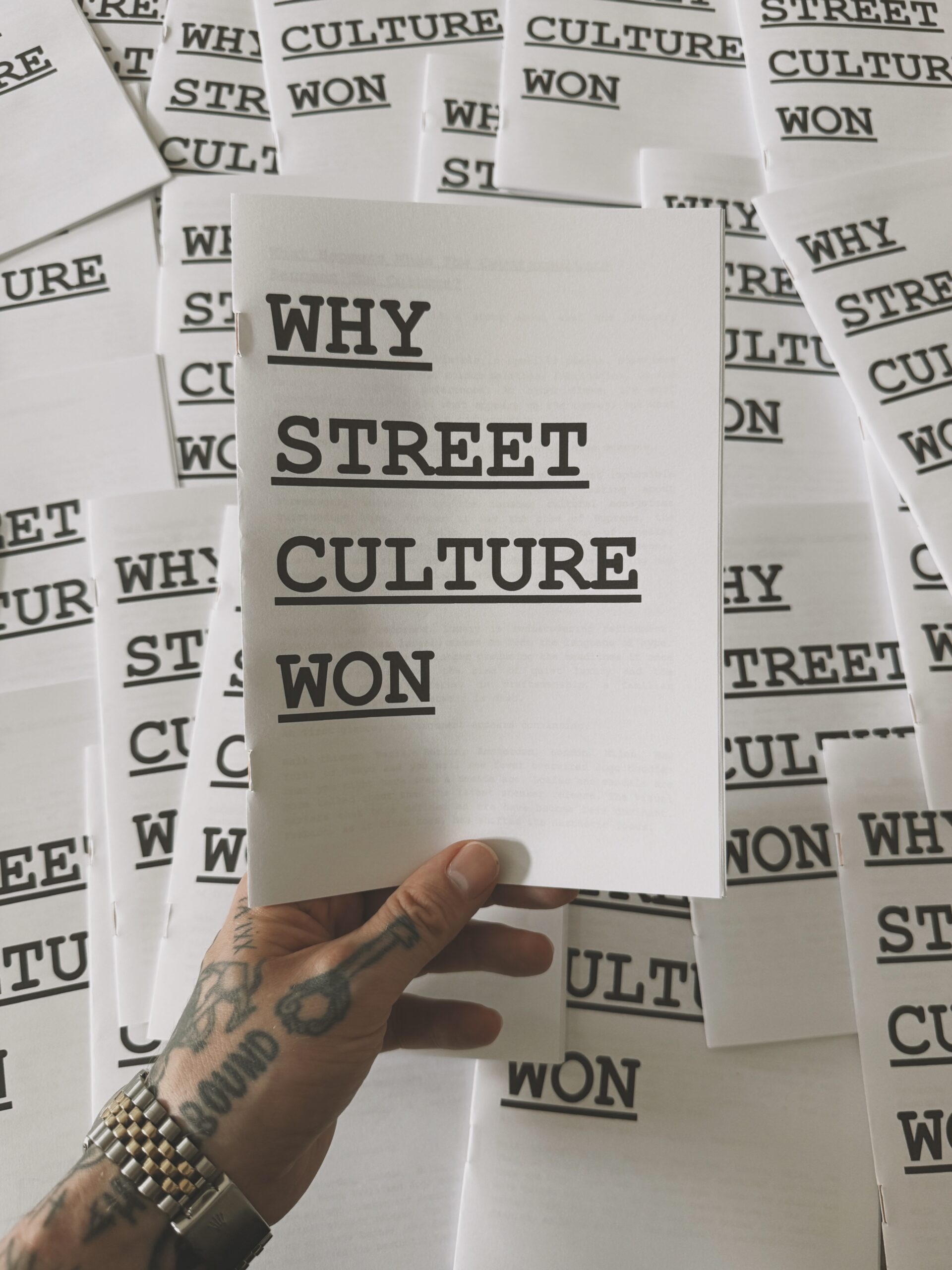
WHY STREET CULTURE WON
What Happens When The Counterculture Becomes The Culture?
Every fashion week tells a story about what the industry currently values.
Sometimes that story is visible in specific pieces. Sometimes it reveals itself through colour palettes, fabrication, or the return of forgotten references. At other times, the most interesting story is not what appears on the runway, but what quietly disappears from the conversation.
Paris Fashion Week in 2026 feels like one of those moments.
For the better part of two decades, it was almost impossible to discuss contemporary fashion without talking about streetwear, sneakers, or the broader cultural ecosystems surrounding them. Whether it was the rise of Supreme, the influence of Virgil Abloh, the globalisation of sneaker culture, or luxury fashion’s fascination with youth movements, street culture became one of the defining forces shaping how brands communicated, collaborated, and created desire.
But today, the conversation feels different.
Tailoring has returned. Luxury is rediscovering refinement. Fashion media has largely moved on from the language of hype. The resale market is no longer producing the headlines it once did. Somewhere between the rise of quiet luxury and the industry’s renewed interest in craftsmanship, a familiar narrative emerged: streetwear is dead.
At first glance, the argument appears convincing.
Walk through Paris, Berlin, Amsterdam, London, Milan, New York, or Tokyo and you will see fewer oversized logo hoodies than you might have seen a decade ago. Loafer and sandals are more talked about than the latest sneaker release. The visual markers that once defined an era have become less dominant. Fashion, as it often does, has shifted its aesthetic focus.
Yet aesthetics and culture are rarely the same thing.
Because while the industry continues to debate the relevance of streetwear, many of the ideas that emerged from street culture have quietly become foundational to how contemporary brands operate – regardless of whether they see themselves as streetwear. Collaboration remains one of the most powerful tools in modern marketing. Community has become a boardroom obsession. Scarcity continues to drive demand. Cultural credibility often matters as much as product quality. Storytelling is the key. Consumers increasingly expect participation rather than passive consumption.
These are not luxury fashion inventions – they come from street culture.
They did not emerge from management consultancies, business schools, or marketing departments. Most of them were developed, tested, and refined within communities that existed far outside traditional centres of influence. Skateboarders built communities before brands talked about community building. Hip-Hop created cultural ecosystems before marketers discussed creator economies. Hardcore-Punk showed the youth the importance of emotional storytelling before some Social Media experts added it to their Instagram caption. Sneaker culture understood participation long before media outlets turned participation into a business model.
The more closely one examines contemporary culture, the harder it becomes to ignore a curious reality. Many of the systems that define modern branding, modern communication and modern relevance originated in places that were once dismissed as niche, underground or culturally insignificant. Which raises a question that feels particularly relevant in Paris today:
What happens when the counterculture becomes the culture?
Because perhaps the most significant story in fashion over the last 40 years is not the rise of luxury, the acceleration of digital commerce, or the emergence of social media.
Perhaps it is the story of how a collection of local scenes, youth movements, and subcultural communities gradually reshaped the way the world thinks about identity, belonging, and value.
The story of street culture has often been told through products: Sneakers. Hoodies. Graphic T-Shirts. Limited editions. Collaborations. But those objects were never the story. They were evidence of something larger.
The real story has always been about people. About communities creating meaning. About identities being negotiated through participation. About cultural influence moving from the margins toward the centre. And about what happens once it gets there.
Why Sneakers Were Never About Sneakers
In April 1985, Nike released a black and red basketball shoe that would eventually become one of the most important cultural products of the modern era.
At the time, nobody could have known that.
Not Nike. Not this guy named Michael Jordan. Not the league he was playing for, the NBA. Certainly not the millions of people who would spend the following decades collecting, discussing and obsessing over sneakers as if they were something far greater than sportswear.
Looking back, it is tempting to treat the rise of the Nike Air Jordan 1 as inevitable. Like the beginning of a story whose ending was already written. But culture rarely works that way. Most movements only become coherent in retrospect, once enough time has passed for us to connect the dots.
What made the Air Jordan 1 significant was never simply the shoe itself. The now-famous „Banned“ campaign remains one of the most enduring examples of this. Whether the sneaker was actually banned by the NBA in the way popular culture remembers it has become almost irrelevant. The story survived because it represented something larger than footwear. It spoke to rebellion, individuality, and the growing sense that cultural influence could emerge from outside traditional institutions.
In many ways, that idea sits at the heart of sneaker culture itself.
The challenge with writing about sneakers today is that it is easy to mistake the object for the story. Sneakers are tangible. They can be photographed, reviewed, archived and sold. Culture is more elusive. It reveals itself through behaviour, rituals, and communities. Yet it is these invisible systems that transformed sneakers from athletic equipment into cultural artefacts.
To understand why sneakers became so important, it helps to leave the sneaker store entirely and look instead at the worlds that gave them meaning. Basketball was one of those worlds. Hip-Hop was another. Skateboarding, youth culture, and the cities that shaped them were equally important.
What connected these seemingly different environments was not a product – even though it naturally makes sense to wear a good sports shoe when playing basketball or skateboarding in a halfpipe – but a shared desire for self-expression. At a time when traditional markers of identity often felt inherited rather than chosen, sneakers offered something different. They became part of a visual language through which people could communicate who they were, what they valued and where they felt they belonged.
That distinction matters because the story of sneakers is ultimately a story about identity.
A teenager in New York could identify with basketball culture. A skateboarder in California could align themselves with a local scene. A Hip-Hop fan in Paris could feel connected to artists and communities thousands of miles away. Sneakers became cultural passports, allowing people to move between worlds and signal their participation in them.
This happened at a moment when those worlds were beginning to collide. Basketball was becoming global. Hip-Hop was becoming global. Media was becoming global. Sneakers travelled alongside them, absorbing meaning from each community they touched.
Looking back from 2026, this feels almost obvious. Entire industries now rely on creators, communities, and cultural credibility. Yet many of these dynamics were still emerging at the time. Sneaker culture did not invent them, but it became one of the environments in which they were most clearly visible. What followed over the next four decades was not simply the growth of a market. It was the expansion of a cultural language.
Basketball players became style icons. Musicians became tastemakers. Skateboarders influenced everything. Sneakers moved freely between these worlds, carrying different meanings depending on where they landed. The products remained relatively consistent. The stories surrounding them did not.
This is why the history of sneakers cannot be understood through the product alone. It’s the culture that creates the value. Objects become important not because of what they are, but because of what they come to represent.
Which is why the history of sneakers is ultimately not a story about footwear at all.
It is a story about people. About how communities create meaning, how objects become symbols, and how culture transforms products into something larger than the products themselves. By the time sneakers became a global industry worth billions of euros, their most significant contribution had already taken place. They had demonstrated that cultural value and commercial value are rarely separate forces. More often than not, one creates the other.
The story of sneakers, in other words, was never really about sneakers. It was about everything that followed.
How Street Culture Became The Blueprint For Modern Culture
Few words have shaped fashion over the past three decades as profoundly as streetwear. Few have also become as difficult to define.
Part of the confusion stems from the fact that streetwear has always meant different things to different people. For some, it describes a visual language built around graphic T-shirts, hoodies, and sneakers. For others, it refers to a generation of brands that emerged from skateboarding, Hip-Hop, and overall youth culture. For many, it represents an era that has already passed.
This ambiguity sits at the centre of the recurring debate about streetwear’s supposed decline.
Every few years, fashion develops a habit of announcing the death of something. Sometimes it is a silhouette. Sometimes it is a trend. Sometimes it is an entire cultural movement. Streetwear has become one of the latest subjects of this cycle. The argument is familiar. Luxury has rediscovered tailoring. Quiet luxury has replaced logo-heavy dressing. Sneakers no longer dominate cultural conversations in the way they once did. Therefore, streetwear must be over.
At first glance, the logic appears convincing. The problem is that it mistakes aesthetics for influence.
To understand why, it helps to return to a time before streetwear existed as a market category.
Many of the brands now associated with streetwear never set out to create a movement. Shawn Stussy was not building a global fashion business when he began printing his signature on T-shirts in Southern California. James Jebbia did not open Supreme with the ambition of reshaping luxury fashion. Both projects emerged from communities before they became businesses. They reflected existing cultural realities rather than responding to market opportunities.
This distinction is important because it reveals what made streetwear influential in the first place. Its significance was never rooted solely in clothing or a product.
The products mattered, of course, but they were rarely the entire story. What people were buying into was a world. A set of references. A shared language. A feeling of participation in something larger than themselves. Streetwear understood early on that products become more meaningful when they are connected to communities, stories, and identities. Long before businesses spoke about engagement or cultural relevance, these brands were already creating spaces where those things could emerge naturally. Traditional brands historically built a community around the product they sold – streetwear had a community to sell products to.
Looking back, this may have been streetwear’s most significant innovation.
Not the hoodie. Not the sneaker. Not the graphic T-shirt. They were merely the canvas. But a different understanding of how value is created.
Traditional fashion largely operated through aspiration. Meaning flowed from institutions to consumers. Streetwear introduced a more participatory model. Communities shaped brands as much as brands shaped communities. Cultural influence moved horizontally rather than vertically. What mattered was not simply what people wore, but what wearing it allowed them to communicate.
The impact of this shift extends far beyond fashion.
Consider collaboration. Today, collaborations are so common that they feel almost inevitable. Luxury houses collaborate with sportswear brands. Musicians collaborate with designers. Technology companies collaborate with artists. Entire industries now rely on collaboration as a mechanism for generating attention. Yet collaboration did not originate as a marketing strategy.
Within street culture, collaboration functioned as a cultural signal. It reflected relationships, shared values, and mutual respect between communities. The business opportunity emerged later. What many organisations adopted was the format. What made the format meaningful was the culture underneath it.
The same pattern appears in discussions around scarcity. Modern luxury frequently relies on exclusivity to generate desire, yet sneaker culture demonstrated decades ago that scarcity was never simply an economic mechanism. It was a social one. Scarcity rewarded participation. It encouraged attention. It transformed products into stories and ownership into cultural currency.
Most importantly, streetwear helped redefine the relationship between institutions and audiences. Consumers were no longer expected to simply observe culture. They were invited to participate in it.
Today, that idea feels entirely normal.
Social media depends on participation. Creator culture depends on participation. Communities increasingly expect participation. Yet these behaviours did not emerge in isolation. They evolved through decades of interaction between brands, scenes and communities that understood culture as something people created together rather than consumed passively.
This may explain why declarations about the death of streetwear often feel incomplete.
Streetwear undoubtedly changed. Every cultural movement does. Certain aesthetics disappeared. Others became mainstream. Some brands lost relevance while new ones emerged.
What remained were the underlying ideas: Community. Participation. Collaboration. Cultural relevance.
These concepts became so widely adopted that they eventually detached themselves from their origins. They stopped looking like innovations and started looking like common sense. In many ways, this is what happens when a cultural movement succeeds. Its most influential contributions become invisible. Nobody spends much time thinking about the systems that shape everyday life until those systems disappear. Streetwear reached a similar point. Its aesthetics continue to evolve, but many of the ideas it introduced have become embedded within the way modern culture operates.
Which is why the more interesting question is not whether streetwear is dead. The more interesting question is whether its influence became so widespread that we stopped recognising it altogether.
Because the most successful cultural movements rarely disappear. They become part of the operating system. And once that happens, their influence extends far beyond the products that first made them visible.
Why Brands Understand Trends But Need To Understand Culture
Sometime over the last few years, football jerseys escaped football (and yes, my fellow US citizens, I’m talking about soccer).
Not entirely, of course. They still belong to stadiums, supporters, and the rituals that have shaped the game for generations. Yet they now seem to exist somewhere else as well. Fashion magazines style them with tailored trousers and luxury accessories. Vintage shirts trade for prices that would have seemed absurd only a decade ago. Designers reference them on runways. Young people wear them despite having little interest in the clubs they represent (“Name one player!”).
What was once primarily sportswear has become something else entirely: a cultural object moving freely between different worlds.
The obvious explanation is that football jerseys became a trend. The more interesting explanation is that they never stopped being culture.
Long before fashion rediscovered them, football shirts carried stories about geography, identity, loyalty, and belonging. They represented neighbourhoods, cities, generations, wins, and losses – and stories. They reflected local histories while simultaneously connecting people to something larger than themselves. By the time they appeared in fashion editorials, much of their cultural significance had already been established.
The trend became visible. The meaning underneath it had existed for years. This distinction helps explain one of the defining challenges facing modern organisations.
Over the past decade, businesses have become remarkably sophisticated at identifying signals. Social listening tools track conversations in real time. Trend reports arrive with increasing frequency. Consumer behaviour can be monitored, measured and visualised in ways previous generations could hardly imagine.
In theory, culture has never been easier to observe.
And yet cultural relevance remains surprisingly difficult to achieve.
Part of the reason is that visibility and understanding are not the same thing. Seeing a movement emerge is different from understanding why it matters. That’s why you can learn marketing, but you have to live culture.
Most organisations can identify a trend once it becomes visible enough. Far fewer can explain the conditions that produced it in the first place. Street culture offers countless examples of this pattern.
By the time luxury fashion embraced sneakers, sneaker communities had already spent decades building meaning around them. By the time brands began speaking about authenticity, subcultures had long developed their own systems for recognising it. By the time marketers became fascinated with creators, music, and skateboarding, street culture had already demonstrated how cultural influence moves through trusted individuals rather than formal institutions.
Again and again, the same dynamic appears: Institutions notice the outcome. Communities experience the process.
This difference may seem subtle, but it changes everything.
Culture rarely arrives fully formed. It develops slowly, often in places that attract little mainstream attention. It grows through repetition, participation, and shared experience. By the time a movement becomes visible enough to appear in a report or a strategy deck, much of the important work has already happened.
This is why trend forecasting often feels both useful and incomplete. It can identify what is happening, but it struggles to explain why.
The rise of running culture provides another useful example.
For years, running occupied a relatively predictable position within popular culture. It was exercise. It was fitness. It was a competition. Today, however, running increasingly functions as something larger. Across cities around the world, running clubs have become social infrastructures. People join not simply to improve performance, but to meet others, establish routines, and become part of a community.
The growth of running culture is often explained through wellness, health, or changing consumer behaviour. Those explanations are not wrong. They are simply incomplete. Because what many people are ultimately searching for is belonging.
Running provides a reason to gather. A framework for connection. A shared activity through which relationships can form. In that sense, it fulfils many of the same social functions that skateboarding, football, music scenes, and sneaker communities have fulfilled for decades.
The activity matters – sure. But the community matters more.
This is where the culture gap begins to emerge.
Many organisations see behaviour and mistake it for motivation. They see running and assume people are interested primarily in fitness. They see football jerseys and assume people are responding to a trend. They see sneakers and focus on the product rather than the stories attached to it.
The object becomes visible – the meaning remains harder to detect.
Amsterdam’s finest Patta offers a useful illustration of this distinction: From a commercial perspective, Patta sells products. Yet describing Patta through products alone reveals very little about why it became culturally significant. Its influence comes from what it represents: a particular perspective, a particular history, and a particular relationship between the city and the wider cultural landscape. People do not connect with Patta solely because of what it makes. They connect with it because of what it means.
The same observation applies to many of the most influential cultural brands of the last forty years.
What people value is rarely limited to the object itself. They value the stories attached to it, the identities reflected in it, and the communities formed around it.
This is where culture becomes difficult to quantify.
Meaning does not behave like data. It accumulates gradually through relationships, memories, and shared experiences. It attaches itself to places, people, and objects until those things begin to represent something larger than themselves.
Which is why access to information alone is no longer enough.
Most organisations have access to data. Most organisations can identify trends. The real challenge is interpretation, curation, and creation.
Understanding where a movement comes from. Understanding why people care. Understanding the histories, references, and social conditions that give a cultural phenomenon its significance.
Culture is often discussed as if it were a collection of signals waiting to be discovered. In reality, it behaves more like a language. And like any language, fluency requires more than recognising individual words. It requires context, history, and an understanding of the relationships between things.
Perhaps that is the defining challenge facing organisations today:
Not finding culture – culture is everywhere.
Not identifying signals – signals have never been more abundant.
The challenge is learning how to read them.
Because the future will not belong to those who simply observe cultural change.
It will belong to those who understand what that change means.
What Comes Next
One of the most common questions people ask when discussing culture concerns the future:
What comes next?
What is the next streetwear?
What is the next sneaker hype?
What is the next cultural movement capable of reshaping fashion, media, or popular culture?
The questions are understandable. Entire industries have been built around the promise of anticipating change. Trend forecasting, consumer research, and cultural analysis all exist, at least in part, because organisations hope to reduce uncertainty. The future represents opportunity. It represents growth. It represents the possibility of arriving somewhere before everyone else.
Yet the longer one spends observing culture, the less convincing this obsession with prediction becomes.
Not because the future is unimportant, but because culture rarely moves in straight lines.
Few people anticipated that sneakers would become one of the defining cultural objects of the early twenty-first century. Few predicted the extent to which luxury fashion would embrace street culture. Few imagined that football jerseys would become fashion items, that running clubs would evolve into social infrastructure, or that creators would compete with traditional media organisations for cultural influence.
Looking back, most of these developments appear obvious.
At the time, they rarely did.
This may be why the most interesting observers of culture tend to focus less on prediction and more on interpretation and curation.
Rather than asking what comes next, they ask why certain things matter now.
They pay attention to the conditions that allow cultural movements to emerge in the first place.
Throughout this essay, street culture has served as a lens through which to explore those conditions.
At various points, we have talked about sneakers, streetwear, Hip-Hop, skateboarding, football, luxury fashion, and community – I even managed to add Hardcore-Punk to the discussion (might be due to the fact that I’m listening to “Don’t Forget The Struggle, Don’t Forget The Streets” right now). Yet none of these subjects were ever the real story. They were simply different expressions of a larger set of questions about how people create meaning, build relationships, and navigate through the world around them.
This distinction matters because it shifts the conversation away from products and towards people.
The reason street culture remains relevant in 2026 is not that sneakers continue to sell (and they do) or that certain brands remain influential (and they are). Its significance lies in the way it exposed dynamics that now shape much of contemporary life. Long before organisations began speaking about community, participation or authenticity, countless subcultures were already exploring how these ideas functioned in practice. They were experimenting with new forms of belonging, new forms of influence, and new ways of creating cultural value.
What emerged from those communities continues to resonate because the underlying needs have not changed.
People still search for connections.
People still search for identity.
People still search for meaning.
The environments in which those searches take place evolve constantly, but the motivations beneath them remain remarkably stable. And it doesn’t matter if you are talking about Gen X, Gen Y, Gen Z, or Gen Alpha.
This may explain why the lessons of street culture continue to travel so far beyond the environments that produced them.
The products change.
The platforms change.
The aesthetics evolve (and come back sometimes).
The underlying questions remain:
Who am I?
Where do I belong?
Who are my people?
What values do we share?
What story am I participating in?
These questions sit beneath far more of contemporary culture than we often acknowledge. They influence what people wear, what they listen to, who they trust, and how they spend their time. More importantly, they influence how people understand themselves.
Perhaps this is why cultural literacy has become increasingly valuable.
Not because it allows someone to predict the next trend.
Its value lies in helping us understand the present. It allows us to recognise connections between seemingly unrelated developments. It reveals how communities create meaning and how meaning shapes behaviour. It offers context in an era increasingly overwhelmed by information.
The organisations that thrive in the future may not be those that identify every trend first. They may be the ones that understand people most deeply. The ones that recognise that relevance emerges through participation rather than visibility, that communities are built rather than acquired, and that meaning often matters more than attention.
In many ways, these are the same lessons street culture has been teaching for decades.
Which brings us back to the question at the centre of this small little essay:
What happens when the counterculture becomes the culture?
The answer is that its most influential ideas become absorbed into everyday life. They stop looking revolutionary and start looking obvious. Eventually, people forget where they came from, even as those ideas continue shaping the way they see the world.
Perhaps that is the fate of every successful cultural movement.
Its symbols become familiar.
Its aesthetics become commonplace.
Its influence becomes increasingly difficult to see.
Not because it became less important, but because it became part of the foundation itself. Street culture reached that status – the rest of the world is only beginning to realise it.
Street culture did not win because its products became mainstream – it won because its ideas did.
“Why Street Culture Won” by Amadeus Thuener
A publication by STUDIO HIGHFIVESANDSTAGEDIVES | 2026